
Subjects ▲ ▼
About ▲ ▼
What Is It? ▲ ▼
It is used to create/design/maintain Keyboards for use in conjunction with Swiftpos Touch. This includes Keyboards, Layouts and POS Keys
What To Consider? ▲ ▼
- It is NOT recommended to assign an item/product to the bottom right-hand POS Key on a Keyboard Layout. This is because this POS Key is used by the Post Linking Layout Method to display a NEXT POS key to allow Clerks/Staff Members to proceed to the next Layout when using Layout Linking.
- When setting up security for Order Kiosks, ensure all the Clerk/Staff Groups have been disabled to ensure customers do not have unauthorised access to Swiftpos features/functions.
- To ensure changes to Security are activated in Touch, make sure a Full Update is sent to all Swiftpos Touch devices.
- Fixed Keys are those POS Keys that will appear and function the same for all the Layouts of a Keyboard.
- Adding many Layouts to a Keyboard will impact on the time it takes to load Keyboards in Touch.
- It is recommended that you remove any sample Keyboards from the initial installation if they are not being used.
- If the command line switch /L is being used to set the screen position/size of the Touch screen when invoking Touch, then consideration will need to be given to the font size being used for POS Key Captions, the display of Product Prices and the Numeric KeyPads.
- POS Key Caption suggestions.
POS Key Caption Suggestions? ▲ ▼
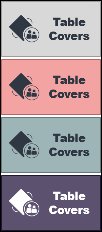
- When using images to be displayed on POS Keys it is recommended to use .PNG graphic files with a transparent background. This then enables the setting of the background colour of the POS Keys. For example:
- Captions can be formatted to be positioned either at the top or bottom of the POS Key. This allows the captions to be positioned so that they do not have to overlay an image. To do this use the Text Align option.
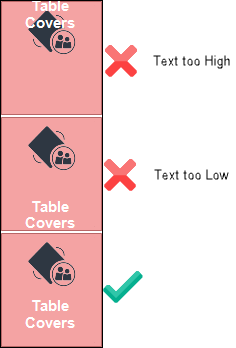
- Captions can also be split over two lines. To do this use the Enter/Return (<CR> Carriage Return) key rather than inserting spaces, to create a new line. For example:

How To? ▲ ▼
- Add A Keyboard?
- Add A Layout To A Keyboard?
- Add A POS Key To A Keyboard Layout?
- Add Images To Keyboards?
- Add / Clear Keyboard Layout Images?
- Assign Locations To A Keyboard?
- Change A Keyboard?
- Configure A Multi Link (#999) POS Key?
- Configure Keyboards For Multi Location Venues?
- Configure A POS Key?
- Copy Keyboard Layouts?
- Copy / Clone A Keyboard?
- Delete A Keyboard?
- Delete A Keyboard Layout?
- Export/Import Keyboards?
- Link A Keyboard Layout?
- Import Keyboard Layouts?
- Move Layouts Between Keyboards?
- Rename A Keyboard?
- Rename A Keyboard Layout?
- Send A Full Update To Touch Devices?
- Set A Keyboard Layout As Home Layout?
- Set The Keyboard Layout Type For Self-Service Kiosks?
- View The Layouts Of A Keyboard?
- View The Structure Of Keyboards?
Screens ▲ ▼
- Alternate Languges
- Clear Items Setting
- Clerk Groups
- Copy or Clone?
- Edit Keyboard Wizard
- Finalise Keys
- Function Keys
- Keyboards
- Keyboard Tree View / Edit
- Layout Tree View
- New Keyboard Wizard
- New Layout
- Products
- Special Keys
- Touch Keyboards
- Touch Layouts
Clear Items Settings Screen ▲ ▼
To be continued ...
Clerk Groups Screen ▲ ▼
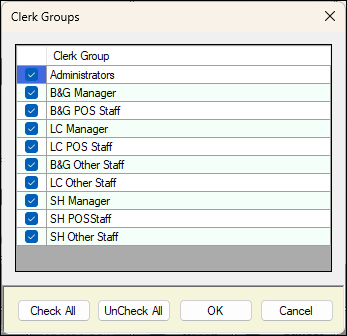
To access, select the POS Key to which access requires restricting and then select the Clerk Security option in the Keyboards screen. Used to restrict access to POS Keys in Touch.
Select from the Clerk Groups listed, those that will be able to have access to the selected POS Key. Then select OK to save the selection.
Copy Or Clone Screen ▲ ▼
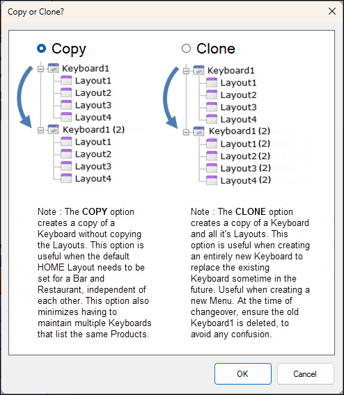
To access, select the Copy / Clone a Keyboard option from the Keyboards menu in the Toolbar. Used to create/design/maintain Swiftpos Touch Keyboards. This includes Keyboards, Layouts and POS Keys.
Edit Keyboard Wizard ▲ ▼
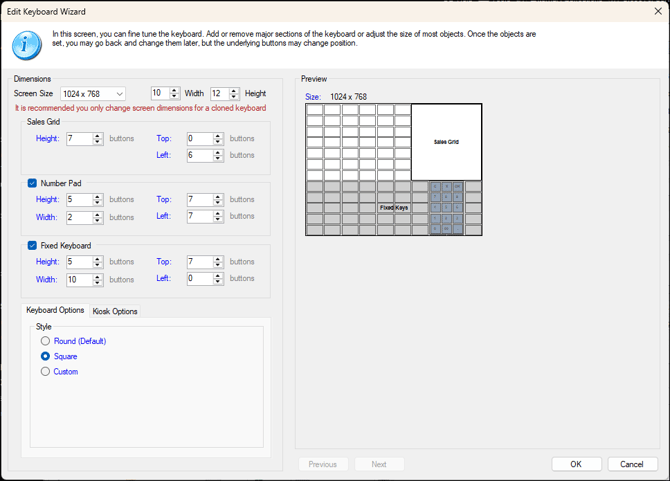
To access, select the Edit Keyboard option from the Keyboards menu in the Toolbar. Used to edit/maintain a Touch Keyboard.
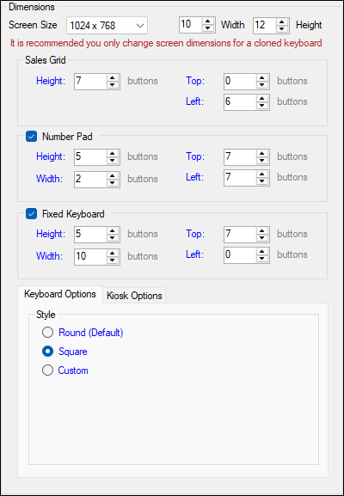
- Screen Size - Displays the size of the screen.
- Width - Displays/Set the width in the number of POS Keys to be displayed from left to right.
- Height - Displays/Set the height in the number of POS Keys to be displayed from top to bottom.
Notes ...
It is recommended to only change the screen dimensions for a cloned Keyboard.
- Sales Grid - Select/Unselect the checkbox option to the right of the text Sales Grid to show/hide the Sales Grid. This option is ONLY enabled when a Kiosk 1 or 2 style Keyboard is being added. It is not enabled for existing Kiosk Style Keyboards.
- Height - Adjust to set the height, in the number of POS Keys, the Sales Grid will overlay.
- Top - Adjust to set the position, in the number of POS Keys, from the top at which the Sales Grid will be located. Zero is the default and will ensure the Sales Grid is positioned at the top of the Keyboard.
- Left - Adjust to set the position, in the number of POS Keys, from the left at which the Sales Grid will be located. Zero is the default and will ensure the Sales Grid is positioned on left of the Keyboard.
- Number Pad - Select/Unselect the checkbox option to the right of the text Number Pad to show/hide the Number Pad.
- Height - Adjust to set the height, in the number of POS Keys, the Sales Grid will overlay.
- Width - Adjust to set the width, in the number of POS Keys, the Sales Grid will overlay.
- Top - Adjust to set the position, in the number of POS Keys, from the top at which the Number Pad will be located. Zero is the default and will ensure the Number Pad is positioned at the top of the Keyboard.
- Left - Adjust to set the position, in the number of POS Keys, from the left at which the Number Pad will be located. Zero is the default and will ensure the Number Pad is positioned on left of the Keyboard.
- Fixed Keyboard - Select/Unselect the checkbox option to the right of the text Fixed Keyboard to show/hide the Number Pad.
- Height - Adjust to set the height, in the number of POS Keys, the Fixed Keyboard will overlay.
- Width - Adjust to set the width, in the number of POS Keys, the Fixed Keyboard will overlay.
- Top - Adjust to set the position, in the number of POS Keys, from the top at which the Fixed Keyboard will be located. Zero is the default and will ensure the Fixed Keyboard is positioned at the top of the Keyboard.
- Left - Adjust to set the position, in the number of POS Keys, from the left at which the Fixed Keyboard will be located. Zero is the default and will ensure the Fixed Keyboard is positioned on left of the Keyboard.
Keyboard Options Tab
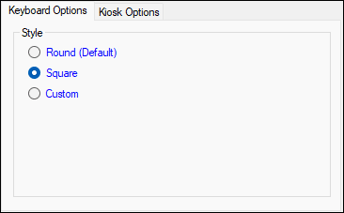
- Style
- Round (Default) - Select to ensure POS Keys, panels, etc. will be displayed with rounded corners and have a gradient appearance. This is the default style.
- Square - Select to ensure POS Keys, panels, etc. will be displayed with square corners and have a flat appearance.
- Custom - Select to display the Custom Options tab and customise the Keyboard appearance as required:
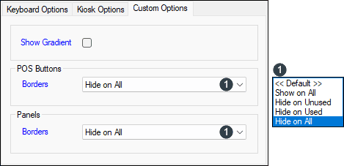
- Show Gradient - This is the default for existing Keyboards. Once selected the background colour of POS Keys and panels will have a gradient appearance.
- POS Buttons
- Borders - Select from the drop-down list one of the available border options.
- Panels
- Borders - Select from the drop-down list one of the available border options.
Kiosk Options Tab
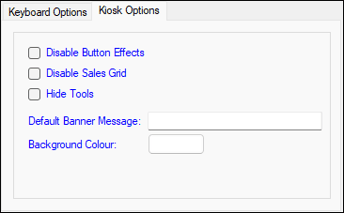
- Disable Button Effects - Select to remove all 3D and background colour effects.
- Disable Sales Grid - Select/Unselect to enable/disable the Sales Grid.
- Hide Tools - Select to hide Swiftpos Touch Toolbar buttons. This is only recommended for use when configuring a Kiosk.
Given, when selected, this option will result in all Toolbar options being hidden (except for the Clerk and Orders button) it is recommended that Run Tool (#900) POS Key is added to the Keyboard, with the Exit Application (More Settings) option selected and Clerk Security is set. Ensure a Full Update is sent to all Touch devices that use this Keyboard, to ensure that the Hide Tools feature is activated.
- Default Banner Message - Displays/Enter the default Banner text. This is generally only used with Kiosks and provides the ability to display a welcome message to customers at the Kiosk.
- Background Colour - Select to set the background colour of the Keyboard.
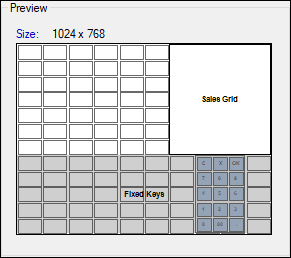
Displays a preview to provide a visual impression of what the Keyboard Layout will look like based on the template settings selected.
Finalise Keys Screen ▲ ▼
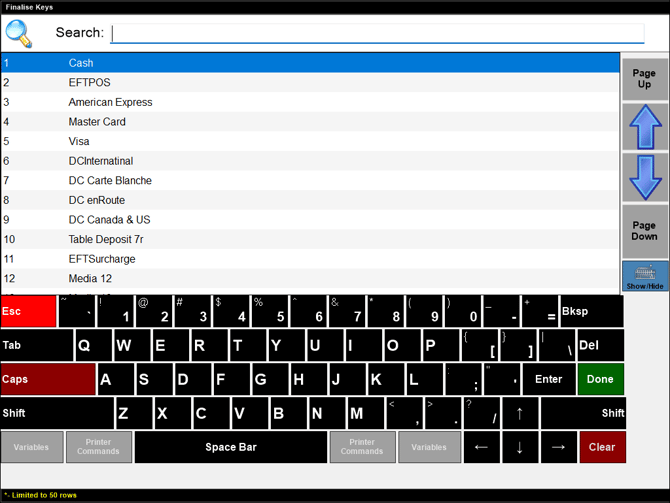
To access, ensure the Finalise Key option is selected in the Link Type drop-down list and select the search option to the right of the Link Item field in the Button Properties section of the Keyboards screen. on the right-hand side of the screen.
- Search - Enter either:
- In full or partial text, enter the name of the Finalise POS Key and select the Done option to filter the Functions listed in the grid with only those have the text entered in their name.
- The ID of the Finalise POS Key and select Done option to return the Finalise POS Key with the ID entered in the grid. If not found, nothing will be returned.
- If no value is entered, then all currently available Finalise POS Keys are returned. Use the navigation option on the right-hand side of the screen to navigate through the list in the grid and locate the Finalise POS Key required.
Lists the Finalise POS Keys that are currently available and that match, if any, the value entered in the Search field above. Lists their ID and Name.
Displays a Touch Keyboard that can be used to enter an ID of full or partial Name of a Finalise POS key in the Search field above.
- Esc - Select to cancel and exit the screen.
- Done - Select to accept the Finalise POS Key currently selected in the grid and return it's ID as the value to be entered into the Link Item field.
Function Keys Screen ▲ ▼
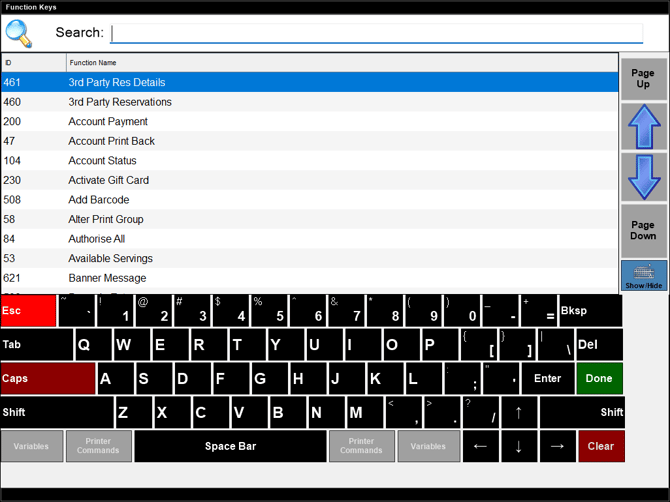
To access, ensure the Function Key option is selected in the Link Type drop-down list and select the search option to the right of the Link Item field in the Button Properties section of the Keyboards screen. on the right-hand side of the screen.
- Search - Enter either:
- In full or partial text, enter the name of the Function POS Key and select the Done option to filter the Functions listed in the grid with only those have the text entered in their name.
- The ID of the Function POS Key and select Done option to return the Function POS Key with the ID entered in the grid. If not found, nothing will be returned.
- If no value is entered, then all currently available Function POS Keys are returned. Use the navigation option on the right-hand side of the screen to navigate through the list in the grid and locate the Function POS Key required.
Lists the Function POS Keys that are currently available and that match, if any, the value entered in the Search field above. Lists their ID and Name.
Displays a Touch Keyboard that can be used to enter an ID of full or partial Name of a Function POS key in the Search field above.
- Esc - Select to cancel and exit the screen.
- Done - Select to accept the Function POS Key currently selected in the grid and return it's ID as the value to be entered into the Link Item field.
Keyboards Screen ▲ ▼
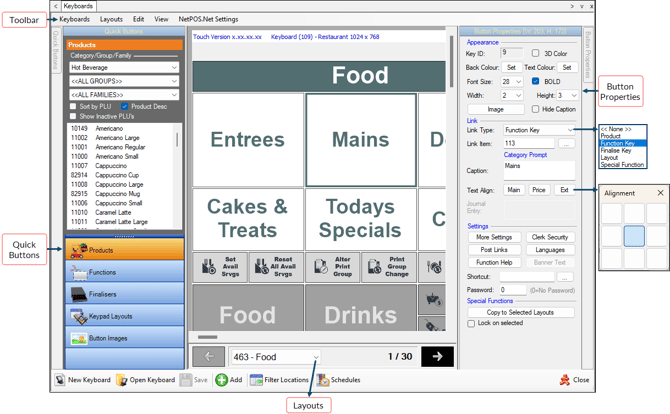
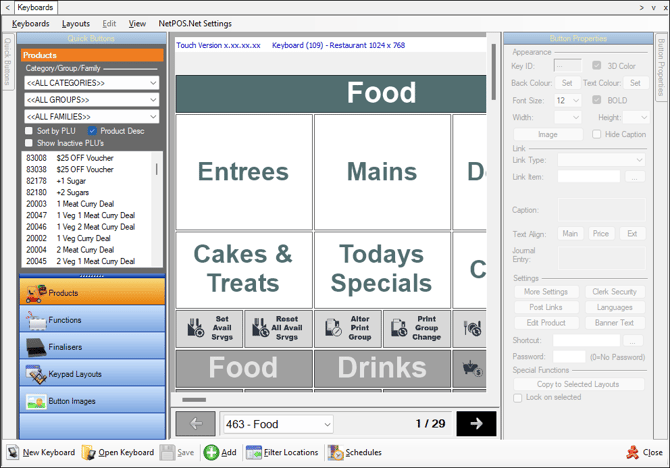
To access, select the Keyboards menu option in the Touch Settings menu in Back Office. Used to create/design/maintain Swiftpos Touch Keyboards. This includes Keyboards, Layouts and POS Keys.

- Edit - Select to view the Edit menu.
- Keyboards - Select to view the Keyboard menu.
- Layouts - Select to view the Layouts menu.
- NetPOS.Net Settings - Select to open the NetPOS.Net Settings menu.
- View - Select to view the View menu.
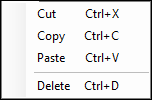
Notes ...
This menu will only be enabled once a Keyboard has been opened and a POS Key in a Layout has been selected.
Select to either Cut, Copy, Paste or Delete the selected POS Key. Multiple POS Keys can be edited by holding down the CTRL Key and selecting one at a time. A POS Key is considered selected when it's border is highlighted.
When pasting POS Keys, they will be pasted from left to right from the selected blank POS Key in Layout, and from top to bottom from the selected blank POS Key in Fixed Key Layouts. POS Keys that are larger than 1 POS Key size will be Pasted as 1 POS Key size and will need to be manually resized if required.
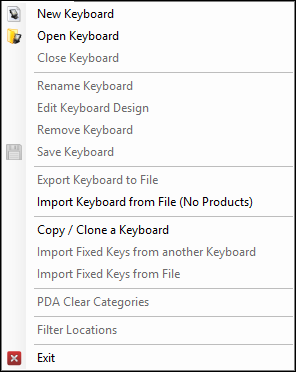
- New Keyboard - Select to open the New Keyboard Wizard screen and create a new Keyboard. Refer HERE for more information.
- Open Keyboard - Select to open the Touch Keyboards screen and select the Keyboard to be opened.
- Close Keyboard - Select to close the current Keyboard.
- Rename Keyboard - Select to open the Keyboard Name pop up and enter a new name for the current Keyboard. Refer HERE for more information.
- Edit Keyboard Design - Select to open the Edit Keyboard Wizard screen to edit the design of the current Keyboard. Refer HERE for more information.
- Remove Keyboard - Select to delete the current Keyboard. Refer HERE for more information.
- Save Keyboard - Select to save changes.
- Export Keyboard to File - Select to export all Keyboards to a XML file. Only Keyboards of the same template styles can be imported/exported. Refer HERE for more information. The exported file can also be used to Import Fixed Keys.
- Import Keyboard from File (No Products) - Select to import previously exported Keyboards. This will import a selected Keyboard from the Import file specified. It will be imported, maintaining the same Layout, Functions and Media POS Keys as the original. However, it will exclude the items/products, thus allowing for different items/products to be added in manually. For example, for Fuel Station outlets, there may be a need to have the same Keyboards across outlets, with each outlet having it's own items/products. Refer HERE for more information.
- Copy / Clone a Keyboard - Select to open the Copy or Clone screen to copy/clone an entire Keyboard. Refer HERE for more information.
- Import Fixed Keys from another Keyboard - Select to import fixed POS Keys from another Keyboard. Refer HERE for more information.
- Import Fixed Keys from File - Select to import Fixed Keys from a previously exported XML file. Refer HERE for more information.
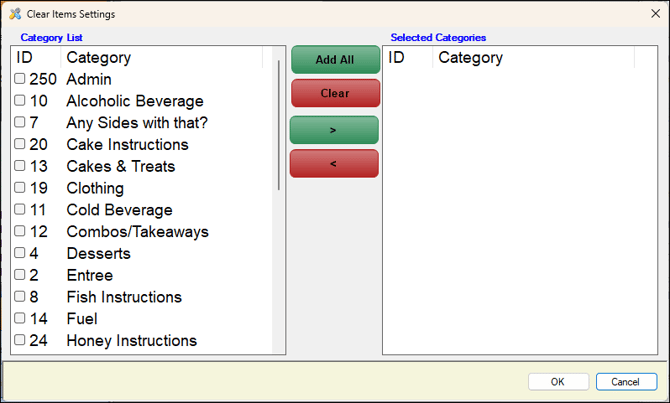
- PDA Clear Categories - Select to open the Clear Items Settings screen to manage the Categories of items/products available to a PDA and therefore identify the items/products that will be available to a PDA. Refer HERE for more information.
Notes ...
This option is only displayed if the Keyboard currently open, is a Mobile Keyboard styled Keyboard.
- Filter Locations - Select to open the Locations screen to select the Locations in which the current Keyboard will be available. Refer HERE for more information.
- Exit - Select to exit.
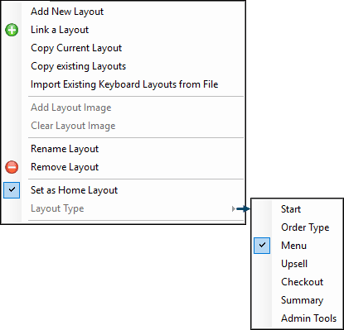
- Add New Layout - Select to display the New Layout screen to add a new Layout to the already opened Keyboard. Refer HERE for more information.
Notes ...
Adding many Layouts to a Keyboard will impact the time it takes to load Keyboards in Touch.
- Link a Layout - Select to open the Touch Layouts screen to link another Layout to the current Keyboard. Refer HERE for more information.
- Copy Current Layout - Select to copy the current Keyboard Layout. Refer HERE for more information.
- Copy existing Layouts - Select to open the Copy Layout from Touch Keyboards screen and select the Keyboard from which all layouts will be copied. Refer HERE for more information.
- Import Existing Keyboard Layouts from File - Select to import Keyboard Layouts from a XML file. Refer HERE for more information.
- Add Layout Image - Select to open the Images Menu screen and add a background image to the Layout. Refer HERE for more information.
- Clear Layout Image - Select to clear the image from the Layout. Refer HERE for more information.
Notes ...
The Add Layout Image and Clear Layout Image options above are only enabled when a Self-Service styled Keyboard is open.
- Rename Layout - Select to rename the currently displayed Keyboard Layout. Refer HERE for more information.
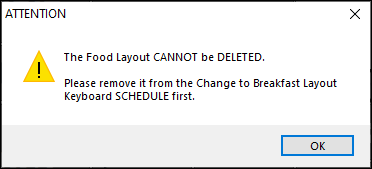
- Remove Layout - Select to delete the currently displayed Keyboard Layout. Refer HERE for more information.
Notes ...
If the Layout is currently scheduled then the following prompt will be displayed:
- Set as Home Layout - Select to set the currently displayed Keyboard Layout as the Home Layout. This means that this will be the initial Keyboard Layout displayed when a Clerk/Staff Member logs in to Touch. Refer HERE for more information.
- Layout Type - Select from the drop-down list one of the Layout types available. Refer HERE for more information on Layout types for a Self-Service Kiosk and HERE for a Self-Service POS.
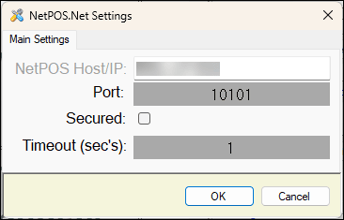
- NetPOS Host/IP - Displays/Enter the domain name (host) or IP address of the NetPOS server.
- Port - Displays/Enter the port number to connect with NetPOS.
- Secured - Select to ensure SSL encryption is used.
- Timeout (sec's) - Sets timeout for NetPOS.Net connection in seconds.
- OK - Select to save the changes and exit.
- Cancel - Select to exit without saving.
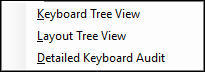
- Keyboard Tree View - Select to open the Keyboard Tree View / Edit screen to view the in-tree structure view of the available Keyboards. Refer HERE for more information.
- Layout Tree View - Select to open the Layout Tree View screen to view the in-tree structure view of the available Layouts for the currently open Keyboard. Refer HERE for more information.
- Detailed Keyboard Audit - Select to generate the Detailed Keyboard Audit (CNKB001) report.
Notes ...
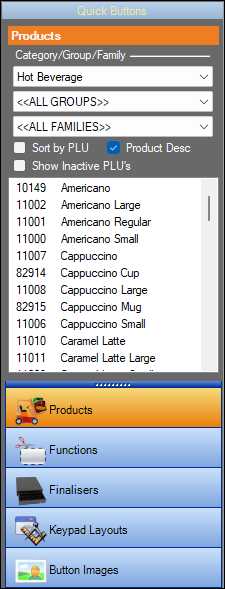
- Products - Select to display the items/products available that can be assigned to a POS Key.
- Functions - Select to display the Functions available that can be assigned to a POS Key.
- Finalisers - Select to display the Finalises/Media Types available that can be assigned to a POS Key.
- Keypad Layouts - Select to display the Layouts available that can be assigned to a POS Key.
- Button Images - Select to display the Images available that can be assigned to a POS Key. Select Add to locate an image file and add to the list displayed. Select Delete to remove the selected Image from the list displayed.
Refer HERE for more information.
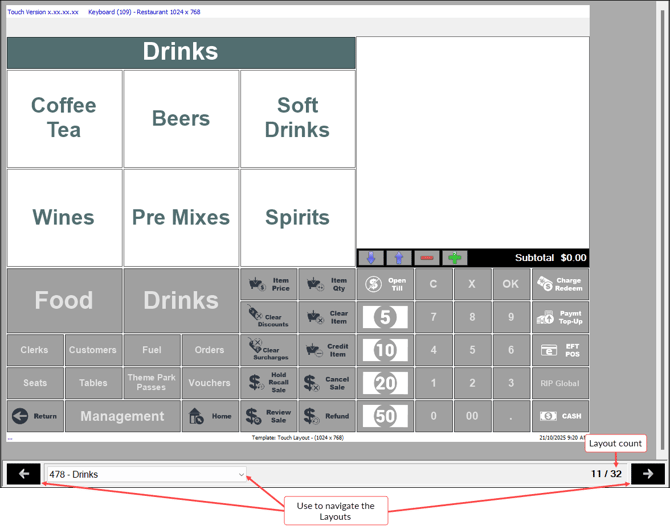
The middle section of the Keyboards screen displays the currently selected Layout. Select from the drop-down list of Layouts one to edit/view.
Notes ...
The Layout currently listed as the first in the drop-down list is the currently designated Home Layout. This can be changed by selecting one of the other Layouts and then selecting the Set as Home Layout option.
Use the left and right navigation arrows at the bottom of the screen to navigate back and forwards through the different Layouts currently assigned to the Keyboard. Or, select from the drop-down list of Layouts.
Buttons Properties Section ▲ ▼
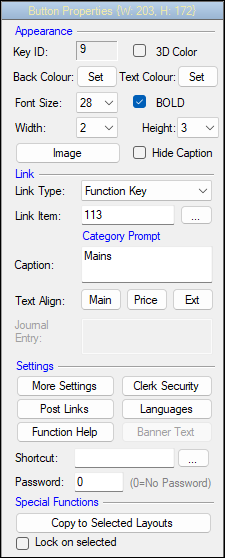
POS Keys can be assigned either using the Quick Buttons displayed on the left-hand side of the screen, or by expanding the Button Properties (right-hand side of the screen) and adjusting the settings. For HERE more information.
Notes ...
The properties of multiple POS Keys can be changed by holding down the CTRL Key and selecting one at a time. A POS Key is considered selected when it's border is highlighted.
Appearance
For a light background, a dark font colour would be needed to obtain maximum contrast. If the Touch device is located in bright lights, then it is not recommended to use white fonts with a dark background because they are hard to read.
- Back Colour - Choose the colour.
- Font Colour - Choose the colour.
- Font Size - Choose the size.
- Width - The POS Key width can be up to 6 POS Keys wide. We recommend that you enlarge the POS Keys to fill the menu layout. It is easy to reduce the size to add more POS Keys if required.
- Height - The POS Key height can be up to 6 POS Keys high.
- Image - Select to open the Images Menu screen and select an Image. Also add an image to a POS Key by selecting the Button Images button to expand the list and then select an Image from the list and drag it onto the required POS Key in the Layouts section.
- Hide Caption - Select to ensure the Caption is NOT displayed. If an image is being used that includes the text, then this option maybe useful to hide the image.
Link
- Link Type - Select from the drop-down list to link the selected POS Key to either one of the following:
- << None >>
- Product
- Function Key
- Finalise Key
- Layout (Keyboard)
- Special Function
- Link Item - Select the button to open the search screen to select either a Product/Function Key/Finalise Key/Layouts or Special Functions or drag and drop them from the Quick Buttons menu onto the Keyboard.
- Caption - Displays/Enter the POS Key caption that will be displayed in Touch. A maximum of 250 characters can be entered. Refer HERE for more information.
Notes ...
If the command line switch /L is being used set the screen position/size of the Touch screen when invoking Touch, then consideration will need to be given to the font size being used here.
- Text Align - Select one of the following to align:
- Main - Select to align the position the Caption will be displayed in the POS Key.
Notes ...
If in Touch the Display Price on Buttons option is selected, you may want to refrain from selecting the cell in the bottom right-hand corner in the drop-down list.
- Text Align continued ...
- Price - Select to align the position the Price will be displayed in the POS Key.
- Ext - Select to align the position of one of the following data values that, if required, will be displayed in the POS Key:
- Available Servings
- Fuel Grade
- Fuel Pump
Notes ...
Consideration will have to be given to the possibility of overlapping occurring, when using this feature. Especially if the Check Available Servings options is selected. It is recommended to confirm all alignment changes are tested and correct before sending Full Updates to all Touch devices.
- Journal Entry - Displays/Enter the caption that will be printed on the Receipt for the selected Finaliser POS Key.
Notes ...
This option is only enabled when a Finalise type POS Key is selected.
Settings
- More Settings - Select to view/edit the additional settings (if any) specific to the selected POS Key. Refer HERE for more information. This option will only be enabled if the selected POS Key has settings to be configured.
- Clerk Security - Select to open the Clerk Groups screen to select which Clerk/Staff Groups can have access to this POS Key.
- Post Links / Multi Link Events - Some POS Keys can have Post Links configured to ensure that either a specific Keyboard Layout or Category prompt is displayed next, OR Multi Links which means that multiple functions can be performed. The Multi Link (#999) POS Key is only enabled/visible when a Multi Link (Macro) POS Key is selected.
- Languages - Select to open the Alternate Languages screen to translate the POS Key caption to other languages.
- Banner Text - Select to enter banner text that will be displayed on the Order Kiosk.
- Password - Enter zero for no password or enter a numeric value to password protect this POS Key.
Special Functions
- Copy to Selected Layouts - Select to ensure the selected POS Key is copied to all other Layouts in the currently opened Keyboard. If these Layouts are shared by other Keyboards, then logically these will also be affected.
Notes ...
This option will only be enabled when the Layout that has been set as the Home Layout, is open.
IMPORTANT
Copying the selected POS Key to all other Layouts will mean that Layouts with POS Keys located in the same position will be overridden. This could mean that some POS Keys are lost.
- Lock on selected - Select to ensure that when the selected POS Key is copied to all other Layouts, it is locked. This means it cannot be modified or moved. This can only be done from the Layout that is set as the Home Layout.
Notes ...
When this option is selected, any new Layouts added will also include the locked POS Key.

- New Keyboard - Select to invoke the New Keyboard Wizard and create a new Keyboard.
- Open Keyboard - Select to open the Touch Keyboards screen and select the Keyboard to be opened.
Notes ...
If the selected Keyboard is already open at another work station, then the following message will be displayed:
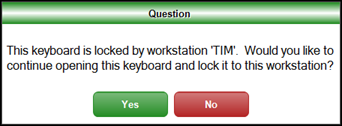
- Save - Select to save changes.
- Add - Select to open the New Layout screen to add a new Touch Layout to a Keyboard. Refer HERE for more information.
Notes ...
Adding many Layouts to a Keyboard will impact on the time it takes to load Keyboards in Touch.
- Filter Locations - Select to open the Locations screen to select those Locations in which the currently selected Keyboard will be active.
- Schedules - Select to Schedule Keyboard Layouts to change the default layout to selected layouts at specified times.
- Close - Select to exit.
Keyboard Tree View / Edit Screen ▲ ▼
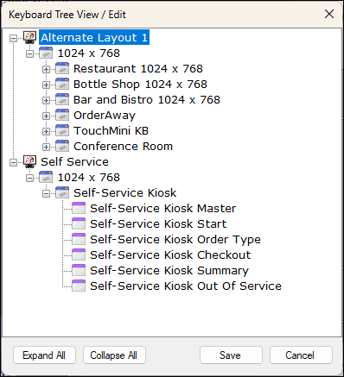
To access, refer HERE. Used to view an in-tree structure view of the available Keyboards. It lists the Keyboards and their Layouts under a tree type structure based on Keyboard Style, then Screen Size and then by Keyboard Name. It can also be used to move (drag and drop) a Layout from one Keyboard to another. Once moved, select Save to save the change.
Layout Tree View Screen ▲ ▼
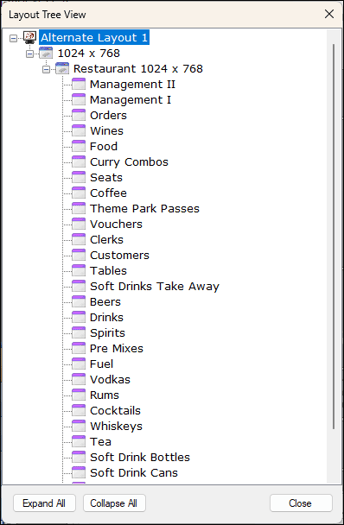
To access, refer HERE. Used to view an in-tree structure view of the available Layouts for the currently open Keyboard. It lists the Layouts for the currently open Keyboard under a tree type structure based on Keyboard Style, then Screen Size and then by Keyboard Name.
New Keyboard Wizard ▲ ▼
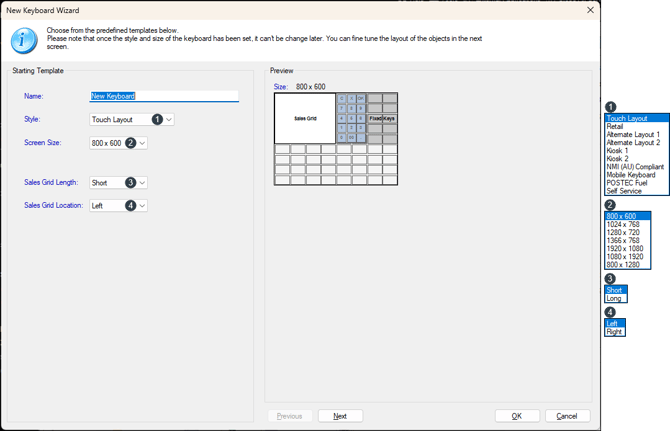
To access, select the New Keyboard option from the Keyboards menu in the Toolbar or select the New Keyboard option in the footer section. Used to create a new Keyboard for Touch.
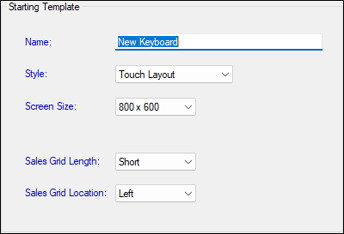
- Name - Enter an appropriate name to easily identify the Keyboard.
- Style - Select from the drop-down list one of the following:
- Touch Layout - Select to configure a Keyboard for Touch.
- Retail
- Alternate Layout 1
- Alternate Layout 2
- Kiosk 1
- Kiosk 2
- NMI (AU) Compliant
- Mobile Keyboard
- POSTEC Fuel
- Self Service - Select to configure a Self-Service Kiosk. The screen size supported by this option is 1920h x 1080w pixels. It does NOT support any other size. Refer HERE for more information.
- Screen Size - Select from the drop-down list of available options the one most appropriate. This option is NOT available when the Self-Service Style option is selected.
- Sales Grid Length - Select from the drop-down list of available options the one most appropriate. This option is NOT available when the Self-Service Style option is selected.
- Sales Grid Location - Select from the drop-down list of available options the one most appropriate. This option is NOT available when the Self-Service Style option is selected.
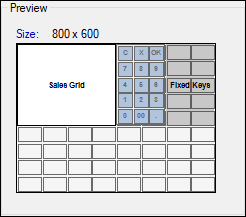
Displays a preview to provide a visual impression of what the Keyboard Layout will look like based on the template settings selected.

- Previous - If enabled, select to move to the previous step in the wizard.
- Next - If enabled, select to move to the next step in the wizard and display the screen HERE titled New Keyboard Wizard.
- OK - Select to save changes and exit.
- Cancel - Select to exit without saving changes.
New Layout Screen ▲ ▼
New Layout Screen for non-Self-Service styled Keyboards
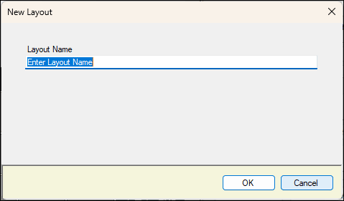
New Layout Screen for Self-Service styled Keyboards
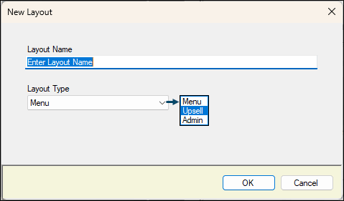
To access, select the Add option in the Footer section. Used to enter the name of the new Touch Layout being created for the currently opened Keyboard.
Special Keys Screen ▲ ▼
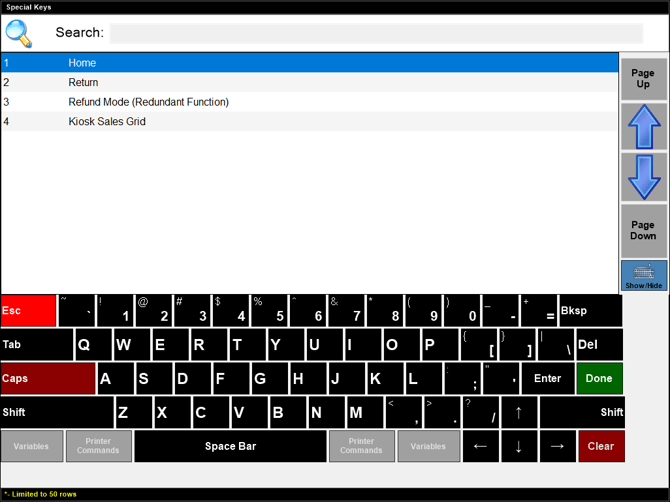
To access, ensure the Special Function option is selected in the Link Type drop-down list and select the search option to the right of the Link Item field in the Button Properties section of the Keyboards screen. on the right-hand side of the screen.
- Search - Enter either:
- In full or partial text, enter the name of the Special POS Key and select the Done option to filter the Functions listed in the grid with only those have the text entered in their name.
- The ID of the Special POS Key and select Done option to return the Special POS Key with the ID entered in the grid. If not found, nothing will be returned.
- If no value is entered, then all currently available Special POS Keys are returned. Use the navigation option on the right-hand side of the screen to navigate through the list in the grid and locate the Special POS Key required.
Lists the Special POS Keys that are currently available and that match, if any, the value entered in the Search field above. Lists their ID and Name.
Displays a Touch Keyboard that can be used to enter an ID of full or partial Name of a Special POS key in the Search field above.
- Esc - Select to cancel and exit the screen.
- Done - Select to accept the Special POS Key currently selected in the grid and return it's ID as the value to be entered into the Link Item field.
Touch Keyboards Screen ▲ ▼
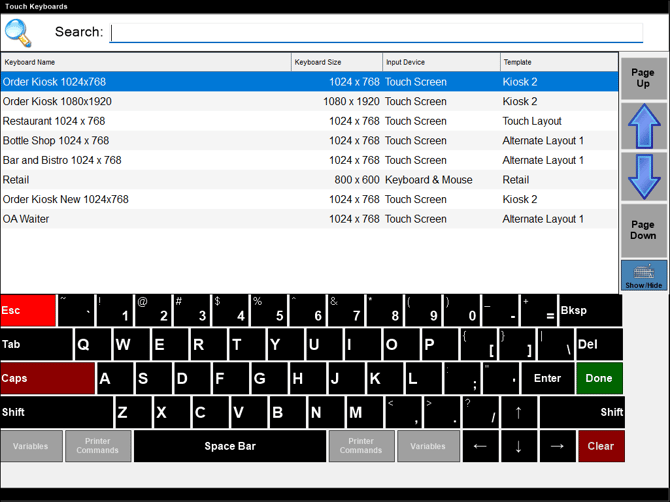
To access, select the Open Keyboard option HERE or the Open Keyboard option HERE.
- Search:
- Enter in full or partial text, the name of the Keyboard and select the Done option to filter the Keyboards listed in the grid with only those have the text entered in their name.
- If no value is entered, then all currently available Keyboards are returned. Use the navigation option on the right-hand side of the screen to navigate through the list in the grid and locate the Keyboard required.
Lists the Keyboards that are currently available and that match, if any, the value entered in the Search field above. Lists their Name, Keyboard Size, Input Device and Template.
Displays a Touch Keyboard that can be used to enter a full or partial name of a Keyboard in the Search field above.
- Esc - Select to cancel and exit the screen.
- Done - Select to accept the Keyboard currently selected in the grid.
Touch Layouts Screen ▲ ▼
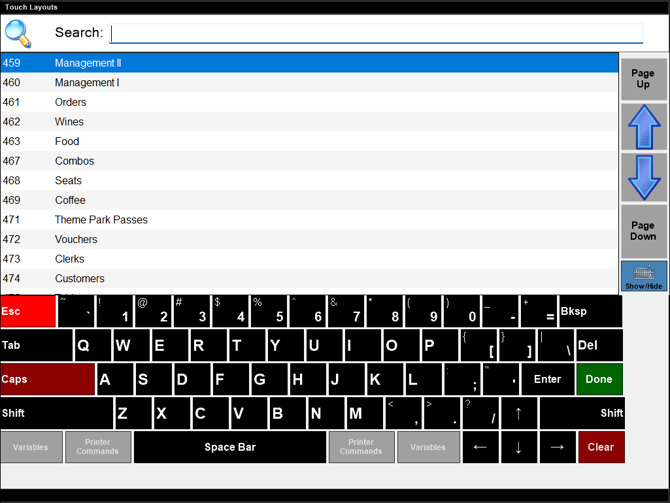
To access, ensure the Layout option is selected in the Link Type drop-down list and select the search option to the right of the Link Item field in the Button Properties section of the Keyboards screen. on the right-hand side of the screen.
- Search:
- Enter in full or partial text, the name of the Layout and select the Done option to filter the Functions listed in the grid with only those have the text entered in their name.
- The ID of the Layout and select Done option to return the Layout with the ID entered in the grid. If not found, nothing will be returned.
- If no value is entered, then all currently available Layouts are returned. Use the navigation option on the right-hand side of the screen to navigate through the list in the grid and locate the Layout required.
Lists the Layouts that are currently available and that match, if any, the value entered in the Search field above. Lists their ID and Name.
Displays a Touch Keyboard that can be used to enter an ID of full or partial Name of a Layout in the Search field above.
- Esc - Select to cancel and exit the screen.
- Done - Select to accept the Layout currently selected in the grid and return it's ID as the value to be entered into the Link Item field.
End of article ▲