
Provides information about Categories and Triggering when used in KVS and in kitchen/order printers in Touch.
Subjects ▲ ▼
Examples ▲ ▼
Only items sold in the trigger Categories will activate sending to KVSs/printers - What this means is that if you have a Kitchen printer set up just to print Pizza orders, whenever there is a pizza ordered, it will also print on the other printers that there is a Pizza to go with the order. This helps staff to know that there are other items to go out to the table with that order, not just the food prepared on that printer. The triggered items print in normal sized print as these items are not being prepared by the chef off this docket. for example:
Example 1
If a Venue had two printers installed as per the example below, the Pizza Bar printer would only include the items/products from the Main Kitchen printer if they were included in the same order/sale.
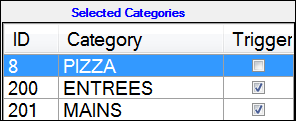
Main Kitchen printer
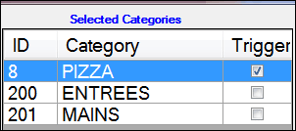
Pizza Bar printer
Example 1
If a Venue had two printers installed as per the example below, then only when a patron orders a coffee and a cake, does the associated items/products print on both printers.
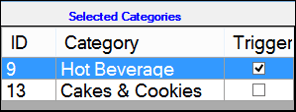
Barista printer
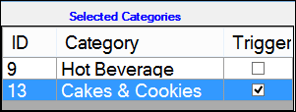
Cake printer
Why Categories? ▲ ▼
KVS and kitchen/order printers make use of Categories configured in Back Office to determine when printing/displaying is triggered, based on the items/products in an order/sale. Categories are used to determine to which KVS/printers, items/products are sent to and displayed.
The following provides a graphic representation of a possible configuration that includes KVSs and printers that make use of Categories.
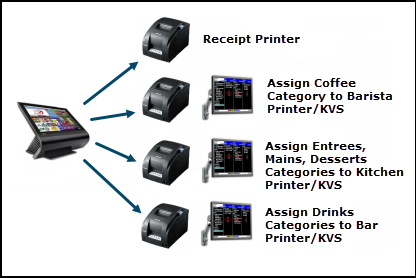
Items/Products that are ordered/sold in Touch, will potentially only be displayed (KVS)/printed if the Category, the items/products are in, is listed in the Shown section for KVS and the Selected Categories section for printers. The displaying of those items/products will depend on whether the Category has the T/Trigger option selected or not. Refer HERE for more information.
It is recommended to reduce the number of Categories down as much as possible for ease of management. The following is an example of the Categories for a small Venue:
-
Entree
-
Mains
-
Desserts
-
Tea/Coffee
-
Sauces
-
Sides
-
Beverage
-
GST Free
-
Admin
Notes ...
It is generally recommended NOT to select Instructional Categories in the Categories screen in Touch, as these automatically print after the parent item is printed. However, the only exception to this would be for a Venue that has a single KVS printer. In this instance is does not matter if an Instructional Category is selected. In contrast, for a Venue that has multiple printers and then Instructional Categories are added to all printers, then every time a Coffee instruction prints to the Barista Printer, it will also print on the other printers, for example the Kitchen printer. The printing order is in ascending order of the number assigned to the Print Group.
Why Triggers? ▲ ▼
Triggering refers to a Category that has the T/Trigger option selected. A Category can only be triggered if it is listed in the Shown section for KVS and the Selected Categories section for printers. A Category can either be triggered or not.
Why Have Categories Selected But Not Triggered? ▲ ▼
To ensure items/products are sent to the KVS/kitchen/order printers when ordered/sold, an item/product needs to be either in:
- A Category that has the T/Trigger option selected.
OR - A Category that is listed in the Shown section for KVS and the Selected Categories section for printers and is in the same order/sale as another item/product that is in a triggered Category.
It is often asked as to why is it that a Category is listed in the Shown section for KVS and the Selected Categories section for printers but does not need to have the T/Trigger option selected. The following KVS example is possibly the best way to explain why.
Example
A patron places an order for a coffee and cake. A KVS (Section type) is configured for the barista's preparation area and a KVS (Pass Bumped type) is configured for the serving counter. Staff serving will need to know when the coffee is ready in order to serve it together with the cake. The coffee is assigned to the Hot Beverage Category and the cake is assigned to the Cakes & Treats Category. The Categories tab in both KVSs will look as follows:
| Barista Section | Serving Counter |
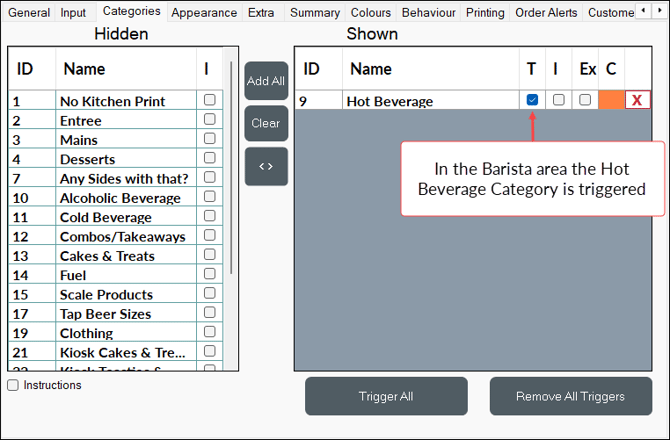
|
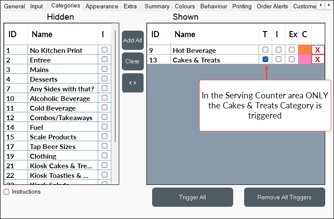
|
Notes ...
In this example, the Bumped Lines option is SELECTED in the Appearance tab of the Serving Counter's KVS and is NOT SELECTED in the Appearance tab of the Barista's KVS.
When paid for, the order/sale for the coffee will appear on the Barista's KVS as follows:
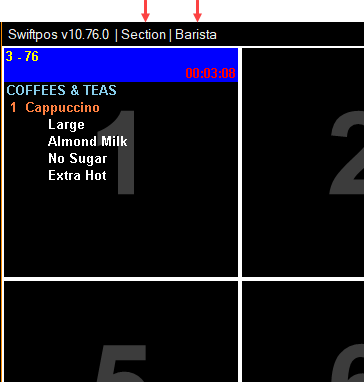
The same order/sale will NOT appear, as yet, on the Serving Counter's KVS. Only when it is bumped by the Barista will it appear as follows on the Serving Counter's KVS:
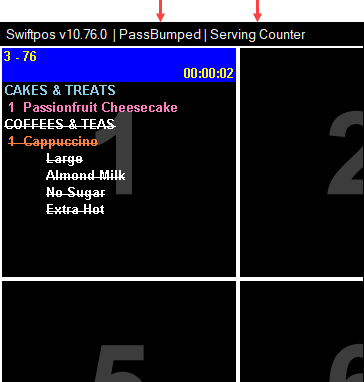
Serving staff can now plate the cake and serve it along with the coffee. Once served it is then bumped from the Serving Counter's KVS and will no longer be visible on that KVS.
End of article ▲